The Provinces Rise: Why French Urban Innovation No Longer Waits for Paris
Mid-sized cities, not the capital, are becoming the places where French startups actually test what the urban transition looks like in practice.
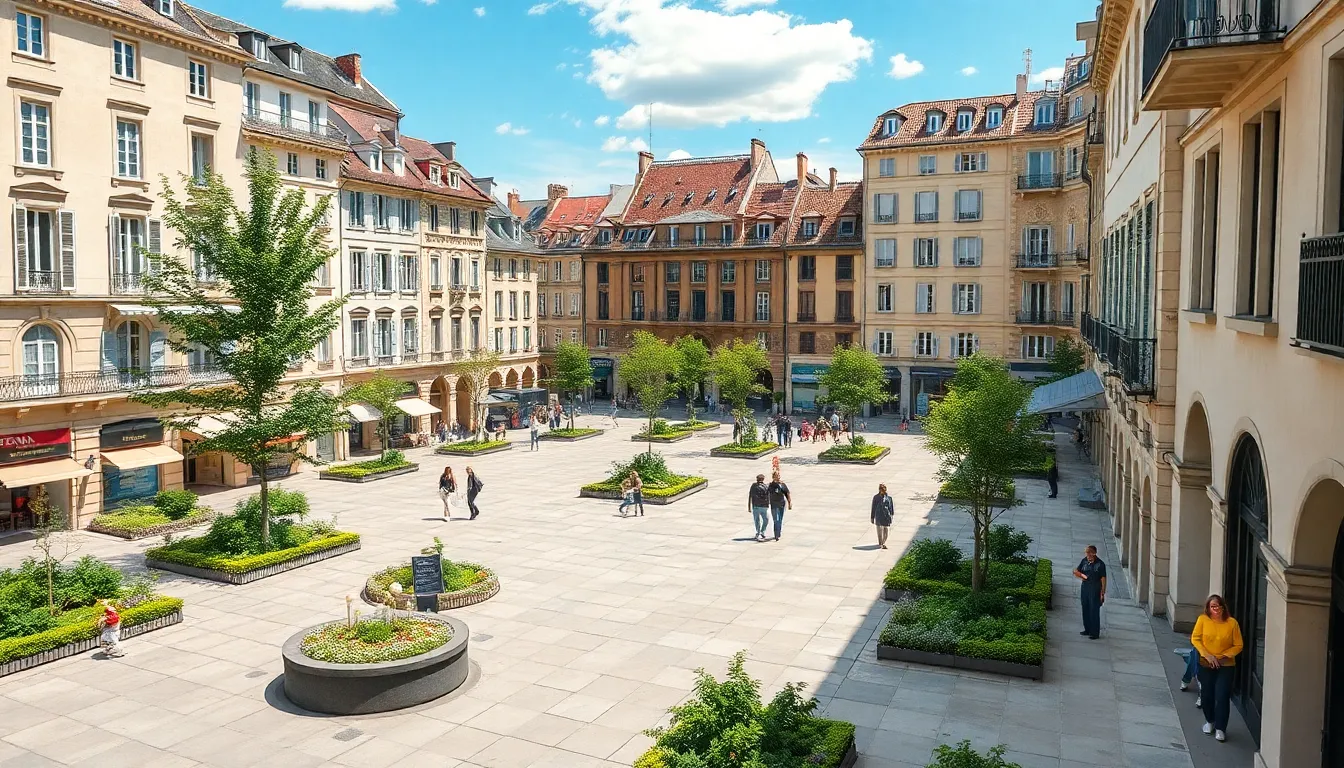
For years, the assumption in French tech was that innovation flowed downward: an idea was born in Paris, refined in an incubator, and only much later "rolled out" to the rest of the country as a finished product. That sequence is breaking down. Increasingly, the places best suited to test digital and environmental solutions for cities are not the largest metropolises but the mid-sized ones, the agglomerations of a few tens of thousands to a few hundred thousand residents where a new mobility service, a waste-sorting sensor, or an energy-monitoring platform can be deployed across an entire municipal network in months rather than years.
The reasoning is structural rather than sentimental. A mid-sized city has enough density and enough public infrastructure, transport networks, waste management, public buildings, energy grids, to make a meaningful pilot possible. But it also has something a metropolis rarely offers: a smaller number of decision-makers, shorter chains of approval, and elected officials who can see a project through from first meeting to citywide rollout within a single mandate. For a startup, that combination, real infrastructure at a manageable scale, is often more valuable than access to a larger, slower-moving capital.
A Paris-Based Program, a Provincial Focus
This shift is visible in how at least one Paris-based accelerator now frames its own role. Ville de Demain, an acceleration program dedicated to urban innovation and led by Nicolas Régnier, is physically anchored at Station F, the Paris startup campus inaugurated in 2017 by Xavier Niel and still the largest of its kind in the world. But the program's stated purpose runs in the opposite direction from its address: it exists to connect French startups working on the digital and environmental transition of cities with local authorities, explicitly including mid-sized cities, not only the handful of metropolises that tend to dominate press coverage of "smart city" projects.
That distinction matters for how the program should be read. Station F's location in Paris says something about where capital and founders convene; it says nothing about where the resulting products are meant to operate. A platform tested in a mid-sized city does not carry the reputational weight of a metropolitan pilot, but it may carry more operational proof, evidence that the technology works under ordinary municipal constraints, with an ordinary-sized technical team and an ordinary budget, rather than under the unusually favorable conditions a flagship metropolis can offer a headline project.
Four Audiences, One Underlying Bet
Programs like this one tend to be built around several distinct groups of people, and mid-sized cities matter differently to each.
- People carrying an early-stage idea who want to work on something with civic purpose find, in a mid-sized city, a scale where a first pilot is conceivable without months of institutional navigation.
- Founders already in an acceleration phase gain something more specific: a place to demonstrate that their product survives contact with a real municipal budget and a real, non-specialist technical team, a harder and arguably more honest test than a metropolitan showcase.
- Innovation, transformation, and CSR teams inside large groups, in sectors such as logistics, waste management, telecoms, transport, and energy, often need exactly this kind of intermediate-scale environment to trial a new process before deciding whether it is worth deploying nationally.
- Elected officials, particularly those governing large collectivities, are the audience for whom the stakes are least abstract. They are the ones who have to decide, in public and with public money, whether an unproven technology is worth the political risk of adoption.
It is this last group that gives the "provinces rising" narrative its real weight. France urbaine, the association that brings together elected officials from France's large cities, agglomerations, and metropolises, roughly a hundred member collectivities, exists precisely because these officials face a common set of questions: how to modernize public services, manage the environmental transition, and do so under budget and political constraints that differ sharply from those of central government. France urbaine is not a partner of any given accelerator and does not fund innovation programs; its relevance here is simply that it represents the exact constituency, elected officials of large and mid-sized collectivities, that urban-innovation programs are trying to reach, and whose caution or appetite ultimately determines whether a pilot becomes a permanent service.
Testing Ground, Not Shortcut
None of this amounts to a guarantee. A pilot in a mid-sized city can fail as easily as one in a capital, and the fact that a program operates out of a well-known Paris address is no evidence of what happens once a solution reaches a town hall two hundred kilometers away. What has changed is the direction of travel: rather than treating provincial deployment as the last, least interesting stage of a French startup's growth, some parts of the ecosystem are beginning to treat it as the stage that actually proves the case.
Programs such as Ville de Demain sit at that junction, based in Paris, built around Station F's density of founders and mentors, but oriented toward collectivities the capital rarely resembles. Whether that orientation produces durable results will be visible only city by city, contract by contract, over years rather than headlines. For now, it is one credible entry point among several in a French urban-innovation landscape that is, slowly, stopping its habit of waiting for Paris to go first.
More stories

What Questions Do People Actually Ask AI About Your Category?
As buyers increasingly ask ChatGPT and Claude for recommendations before they ever visit a website, the real strategic asset isn't a keyword list, it's the exact set of questions being asked.
GEO for Luxury and Premium Brands: Visibility Without Discounting the Image
Wealthy buyers now ask ChatGPT and Claude discreet questions before they call a boutique or a private banker, and a maison's answer to that has nothing to do with a coupon code.
A Dashboard for What AI Says About Your Company: What Good Looks Like
As ChatGPT and Claude become buying-research tools, marketers need something more rigorous than a single confidence score, here's what a serious AI-visibility dashboard should actually contain.