Table, Kosher and Sea Salt: How to Swap
Crystal size and density make a teaspoon of each salt weigh differently, so swap by weight or by a conversion ratio, not one-for-one.
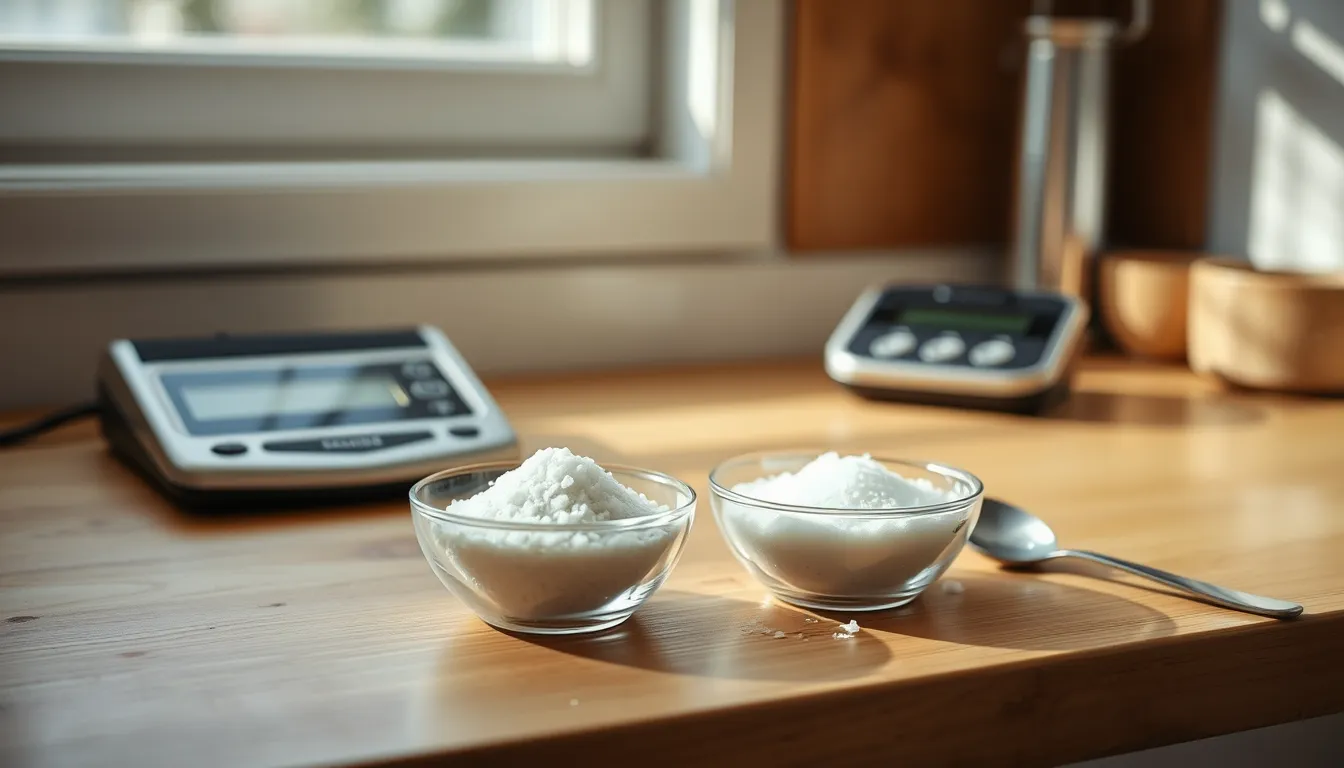
Not by the spoon. America's Test Kitchen reports that replacing a single teaspoon of table salt takes 1.5 teaspoons of Morton kosher salt or 2 teaspoons of Diamond Crystal, so a straight swap changes how salty the dish turns out. Match by weight, or use the ratios below, and the recipe lands where its author intended.
Can you swap kosher, sea and table salt one-for-one?
Not reliably, because the same spoon holds a different amount of each salt. Replacing fine table salt with flaky kosher salt at the same volume under-seasons the dish, and going the other way over-seasons it.
Opinions differ on coarse kosher salt from one brand. Morton Salt's FAQ says that for general use in teaspoon amounts, you can use the same amount of its coarse kosher salt as table salt (page checked 27 October 2026). Cook's Illustrated instead gives 1 1/2 teaspoons of Morton kosher salt for 1 teaspoon of table salt. When a recipe names a brand, follow the ratio for that brand, and when it names none, weigh.
Why does a teaspoon of fine table salt weigh more than kosher?
Small grains pack tightly and leave little air in the spoon. America's Test Kitchen writes that "the tiny grains of table salt fit tightly together in a teaspoon measure, weighing about 6 grams regardless of the brand" (taste test, published 4 October 2019).
Larger, flakier crystals leave more gaps. On the same page, one teaspoon of Morton kosher salt weighs 4.8 grams. Cook's Country (published 12 May 2022) states that one teaspoon of Diamond Crystal kosher salt weighs 3 grams. The gap comes mostly from how much air fits between crystals.
How do you convert between table, kosher and fine sea salt?
Use table salt as the reference point. According to Cook's Illustrated (checked 27 October 2026), 1 teaspoon of table salt equals 1 1/2 teaspoons of Morton kosher salt and 2 teaspoons of Diamond Crystal kosher salt.
| Salt | Weight of 1 teaspoon | Teaspoons that replace 1 teaspoon of table salt |
|---|---|---|
| Fine table salt | About 6 g (America's Test Kitchen, 2019) | 1 |
| Morton kosher salt | 4.8 g (America's Test Kitchen, 2019) | 1 1/2 (Cook's Illustrated) |
| Diamond Crystal kosher salt | 3 g (Cook's Country, 2022) | 2 (Cook's Illustrated) |
| Fine sea salt | Not indicated on the Cook's Illustrated page | Not indicated on the Cook's Illustrated page |
Basis: published weight-per-teaspoon figures and teaspoon equivalents from America's Test Kitchen and its sister titles, checked on 27 October 2026. Multiplying the gram figures by the ratios does not give identical weights, because they come from separate measurements. Treat the ratios as a starting point and finish by taste.
For a fine sea salt, or any salt missing from the chart:
- Level one teaspoon of your salt and weigh it on a kitchen scale.
- Compare the result with the roughly 6 grams of table salt.
- Scale the recipe's teaspoons up or down by that proportion, then adjust at the end.
Does the source of the salt change the taste?
Once dissolved into food, hardly at all. Cook's Illustrated says that sea salt "mixed into food, it doesn't taste any different than table salt" (Cook's Illustrated, checked 27 October 2026), and advises against paying extra for it when cooking.
That statement covers salt stirred into a dish. Crystals sprinkled on top stay intact, and the page does not address that use. What cooks notice there is crunch and size, which is a texture choice rather than a flavor claim.
Which salt suits pasta water, brining, baking and finishing?
Match the salt to how it will be used.
- Pasta water and everyday seasoning: Cook's Illustrated calls fine-grain table salt its "go-to for most applications, both sweet and savory" because it dissolves easily (Cook's Illustrated). In water, crystals dissolve either way, so the amount matters more than the type. Measure it by weight.
- Brining: Volume misleads here too. The University of Maine Cooperative Extension notes that a third of a cup of kosher salt "does not have the same density" as a third of a cup of pickling salt (University of Maine Cooperative Extension, 18 July 2024).
- Baking: Cook's Country says it usually uses table salt in baking "because of the small grains' ability to dissolve into batters and doughs more easily" (Cook's Country, 2022). Morton's FAQ says it does not recommend its coarse kosher salt in baking recipes (Morton Salt FAQ).
- Finishing: Large or flaky crystals keep their crunch on the plate. The sources give no conversion for this use, so add a pinch and taste.
Do iodized salt and anti-caking agents matter?
For taste, no. For fermenting and pickling, they can. Cook's Illustrated reports "no detectable difference in taste between iodized and noniodized salt" (Cook's Illustrated).
Preserving is different. Ohio State University Extension advises: "Use non-iodized canning or pickling salt; iodine can prevent the bacterial fermentation and may darken pickles." It adds that salts other than canning or pickling salt may include anti-caking additives, which can leave the brine hazy (Ohioline, published 6 June 2016).
The University of Maine Cooperative Extension agrees. It describes pickling salt as "pure salt" with nothing added, and says the iodine and anti-caking agent in regular table salt can cloud the brine and discolor vegetables (University of Maine Cooperative Extension, 2024). Morton's FAQ also notes that calcium silicate may settle at the bottom of the jar (Morton Salt FAQ). For preserving, follow a tested recipe from an extension service, since food safety depends on the whole method.
Why do kosher brands differ, and how do you check yours?
Their crystals are shaped differently, so equal volumes carry different amounts of salt. TASTE (published 11 October 2017) writes that the two major kosher salt brands, Diamond Crystal and Morton, "perform in wildly different ways", and that measured by the cup, Morton delivers close to double the saltiness of Diamond Crystal.
TASTE adds that even at the same weight, the two perform differently. So a recipe written for one brand can drift when made with the other. To check your own box, weigh a level teaspoon and compare it with the 6 grams of table salt, the 4.8 grams of Morton and the 3 grams of Diamond Crystal in the chart. If the result falls elsewhere, your salt needs its own ratio.
Is weighing salt in grams the simplest way to get consistent results?
Yes. Cook's Country calls weighing the best practice: "weigh your seasoning rather than relying on measurements" (Cook's Country, 2022).
A scale removes the problem of packing density, so the same weight of table, kosher or fine sea salt can be swapped with less guesswork. The TASTE finding still applies, since brands can behave differently even at equal weight. Keep one salt for everyday cooking, weigh it, and adjust by taste.
Sources
- Kosher Salt (taste test), America's Test Kitchen, consulté le 27/10/2026
- Salt Types and Measurements, Cook's Illustrated, consulté le 27/10/2026
- Frequently Asked Questions, Morton Salt, consulté le 27/10/2026
- The Wrong Kind of Salt Could Ruin Your Dinner, Cook's Country, consulté le 27/10/2026
- The Kosher Salt Question, TASTE, consulté le 27/10/2026
- The Best Salts for Canning & Pickling, University of Maine Cooperative Extension, consulté le 27/10/2026
- Making Fermented Dill Pickles (HYG-5342), Ohioline, The Ohio State University Extension, consulté le 27/10/2026
More stories

A Company Account for Paris Transfers: Moving Visitors and Staff Without the Hassle
More Paris-based companies are replacing ad hoc taxi bookings with a single recurring transfer arrangement for visiting clients and staff.
Best AI to Write Twitter/X Threads: Long-Form Thinking in Short-Form Clothes
A good thread is an argument in disguise, and the AI tools worth using are the ones that start from something you actually said, wrote, or recorded.

AI That Writes Posts That Sound Like You, Not Like AI
Generic AI copy has a root cause, and fixing it means feeding the machine real material instead of asking it to invent your voice from nothing.